benlong


2025 Guide: How to Effectively Test VCB Breaker Testing Machines?
Field failure cost: An undetected vacuum leak on a 24KV VCB led to failure to interrupt a short circuit. This substation outage cost our utility company more than $200,000, and we missed it due to our testing procedures. – Maintenance engineer, regional utility company.
Testing a VCB breaker is not the same as testing a low voltage circuit breaker or MCB. VCBs operate at high/medium voltage levels (typically between 12 kV and 24 kV) and utilize the ability of the vacuum interrupter to operate correctly. In 2025, with the automation of electrical networks being implemented, it is necessary to have specific equipment available to ensure proper functioning of VCBs, which can accurately verify the vacuum integrity of the VCB, mechanical functionality, insulation resistance and contact wear in accordance with IEC 62271-100. This article outlines five primary verifications you need to conduct to test the VCB breaker testing equipment.
This guide covers:
- Five essential tests for VCB breaker testing machines (and how to perform them)
- The following parameters are essential for successful measurement: vacuum level; contact travel; speed of opening/closing; and resistance of insulation.
- How to interpret results against IEC 62271‑100 standards
- Common mistakes and how to avoid them
- FAQs about VCB testing answered by engineers
Understand what a VCB is and why testing matters
Before getting into the testing methods, it is important to remember that the VCB is short for Vacuum Circuit Breaker. A Vacuum Circuit Breaker has a vacuum-type device that will extinguish the arc when the contacts open during a fault condition. In contrast to an oil or air circuit breaker, the Vacuum Circuit Breaker will not have any visible arcing and will require minimal maintenance. However, it is important to test the Vacuum Circuit Breaker because an extremely small amount of vacuum would render the Vacuum Circuit Breaker unable to interrupt a fault. There are automatic test stations built into the automatic production line for testing Vacuum Circuit Breakers, which provide verification of these characteristics on an automatic basis during production.

Five essential tests for VCB breaker testing machines
Five validations must be completed for a total Breaker Test on all VCBs. Every piece of equipment should undergo these validations either once every piece has been tested, or regularly based on what is outlined in the IEC 62271‑100.
Vacuum integrity test (leak detection)
What it measures: The Vacuum Interrupter’s pressure is to be less than 1.33 x 10⁻³ Pa in order to pass inspection. This test is done with either a magnetron or high-voltage vacuum tester, applying a high voltage (up to 70 kV) and measuring emission current through the break contacts. If the current exceeds a threshold level (i.e. 10 µA or less on the 12 kV vacuum interrupter), the vacuum is compromised. The test should be accepted only if there is no continual discharge nor X-ray emission outside those set limits.
A common mistake during these tests is not testing at both ambient conditions and after a heat cycle (if possible). Testing at just ambient conditions results in erroneous test results.
Mechanical characteristic test (travel, speed, timing)
What it measures: Types of travels include contact (stroke), overtravel, opening time, closing time, and average speed of travel.
To Conduct Travel Tests: A VCB Test Set will attach a linear sensor to the moving contact and send a command to open/close the breaker. The results will be recorded as curves. For a 12KV VCB, you should accept an opening contact stroke of 8‑12mm, an opening time of 30‑60ms, and a closing time of 50‑80ms.
Importance of Travel Tests: Slow opening will produce excessive arc energy, while fast closing will lead to bouncing or welding of contacts.
High‑voltage insulation test (withstand voltage)
What it measures: Interrupter and insulation supports dielectric strength tests.
How is it done? Apply 42 kV (for 24 kV VCB) or 28 kV (for 12 kV VCB) for 60 seconds between the open contacts; between each pole and ground. No flashover or leakage currents to be greater than the manufacturer limit (typically <2 mA). (Automation note: in-line insulation testers in a production line (like those in the VCB automated production line) perform this test as 100% complete on every unit at the end of assembly.)
Contact resistance (loop resistance) test
What it measures: Closed primary circuit resistance from terminal to terminal (including vacuum interrupter). Execute the following: utilize micro-ohmmeter (DC 50 – 100A). For VCB’s, acceptable loop resistance for ‘new’ units shall generally be less than 50 micro-ohm’s and less than100 micro-ohm’s for In-Service.
The interpretation of a rising resistive trend indicates either erosion of contact surfaces or misalignment of mechanical connection.
Mechanical endurance (life cycle) test
What it measures: This test measures the capability of a device to endure numerous mechanical operations without breaking down. The testing method involves using an automated test system that will cycle the circuit breaker open and closed a specified number of times (as specified in IEC 62271-100; M1 – 10,000 cycles; M2 – 30,000 cycles). During this process, the test system measures the following parameters: open time, close time, and wear on the contacts of the breaker. When a circuit breaker has been tested 10,000 times, it is expected to have less than 5% increase in its open time.
How to choose and validate a VCB breaker testing machine
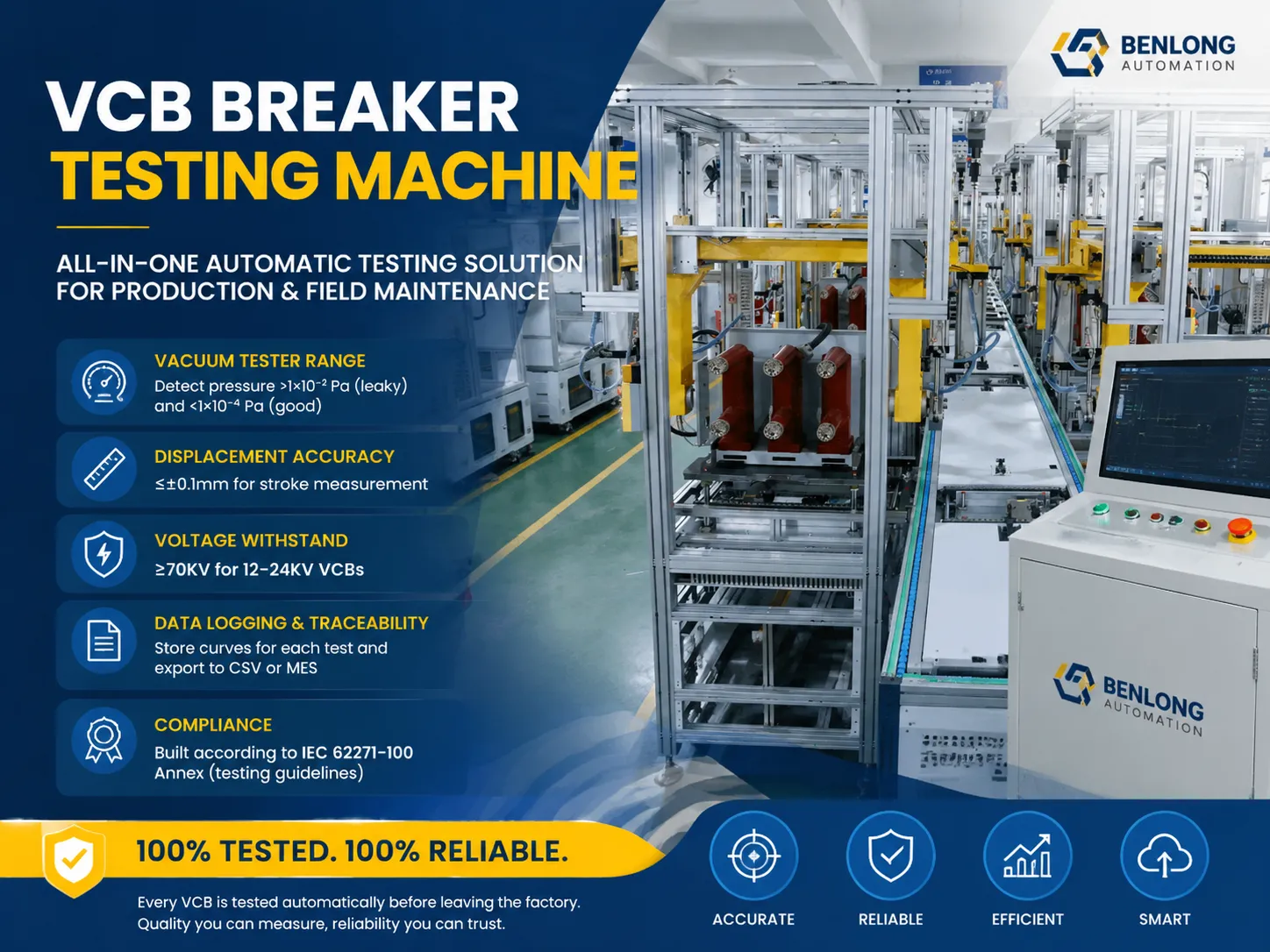
When you evaluate the selection of a Breaker Test machine, the following features should be considered as appropriate for use with VCBs in a production environment or as field maintenance:
- Vacuum tester range: Must be able to detect pressure >1×10⁻² Pa (leaky) and <1×10⁻⁴ Pa (good).
- Displacement sensor accuracy: ≤±0.1mm for stroke measurement.
- Voltage withstand capability: At least 70KV for 12‑24KV VCBs.
- Data logging: Should store curves for each test and export to CSV or directly to MES.
- Compliance: Built according to IEC 62271‑100 annex (testing guidelines).
According to Benlong Automation, their production line combines the above tests into a single smooth flowing process and tests all VCBs (Vacuum Circuit Breakers) will have been tested automatically, 100%, prior to leaving the factory.
Common mistakes in VCB testing and how to avoid them
- Mistake 1: Traditional megger (insulation tester) testing of a vacuum’s integrity was done with an insulation tester (aka, megger). It can be improved by using an independent vacuum tester that applies high voltage (AC or DC) across the open contacts rather than to ground (earth).
- Mistake 2: Not documenting contact travel curves: A single “stroke” value is not enough. You should always record the entire travel vs. time curve as this shows you bounce, overshoot and contact chatter.
- Mistake 3: Not accounting for temperature adjustment for Contact Resistance. In copper, electrical resistance changes 0.4% per degree C. Solution: Measure Temperature or adjust the value to 20 degree C Reference Point.
Frequently asked questions (FAQ)
What is the VCB test?
VCB test This is the complete set of electrical and mechanical verification test schedules that are done on a vacuum circuit breaker to confirm its capability of safely interrupting through faulted currents and withstanding normal operating voltages. The collection has four tests; vacuum integrity test (detect air leaks), insulation withstand voltage testing, measurement of contact resistance, and mechanical characteristic tests (opening / closing times, stroke, speed). These tests are defined in IEC 62271‑100, they are required by type testing, and they are often performed as production routine tests.
What is a VCB used for?
The use of VCBs (Vacuum Circuit Breakers) in switching and protection of MV (Medium Voltage) electrical circuits, which have a maximum voltage of 40.5 kV, is primarily for the following applications: (1) Primary distribution systems within industrial plants (2) Switchgear associated with utility substations (3) Railway electrification systems (25 kV AC) (4) Wind turbine generators (5) Capacitor banks. The preference for VCBs results from their maintenance-free (i.e. no oil, no SF6), enormous electrical life(run time) (30,000 Circuits) and rugged reliability.
How to check VCB?
To check a VCB, you need a specialized Breaker Test set. The step‑by‑step procedure is:
- Isolate the VCB and discharge all capacitive charge (follow lockout/tagout).
- Perform a visual inspection for cracks on the vacuum interrupter glass or ceramic envelope.
- Perform a vacuum-test integrity check by using an HV testing device with a magnetron; supply higher voltages through the contacts and monitor any leakage.
- Measure contact resistance with a micro‑ohmmeter (50‑100A DC).
- Conduct a mechanical operational test by recording total open time, total close time, the stroke length, and average speed with the aid of a travel transducer.
- Conduct a high voltage insulation test (ie – power frequency withstand voltage test) between two phases as well as between phase and ground.
All results must be compared to the manufacturer’s datasheet or IEC 62271‑100 acceptance criteria.
What does VCB stand for in electrical?
Electric engineering includes such names as VCB, which stand for “Vacuum Circuit Breakers”. A vacuum circuit breaker is simply an electrical switch which has been built so that it can break an electrical circuit very quickly in the event of a fault, thus helping to prevent lines or electrical devices from being damaged from overcurrent. In these devices, the way that they operate is through the use of a ceramic or glass enclosure to contain two separate sets of contacts (the “fixed” contact and the “moving” contact); when the contacts are pulled apart by build-up of power or overcurrent (like in the example above), there is an instantaneous electrical arc between the two sets of contacts that is extinguished within milliseconds. As such, these types of electrical devices are dominant in applications between voltages of 3.6KV and 40.5KV (referred to as “Medium Voltage” applications).
The correct approach to testing VCBs in 2025 involves having a systematic way of evaluating the complete integrity of the vacuum, mechanical parts, insulation capability, contact resistance, and mechanical endurance. All the tests must use appropriate testing equipment including magnetron vacuum tester, travel transducer, micro-ohmmeter and high voltage set, with results interpreted in accordance to IEC 62271-100. For high volume production of VCBs there are integrated Breaker Test Lines, such as the new fully automated VCB production line, that reliably and consistently automate each of the above 5 tests, ensuring 100% inspection and data traceability as well as producing 25-30 VCBs per shift on a daily basis. Whether you work as an engineer for a utility company or are responsible for manufacturing and testing VCBs, this document is provided to ensure that you can prevent costly consequences if any of the above VCB Test Failures occurs.