benlong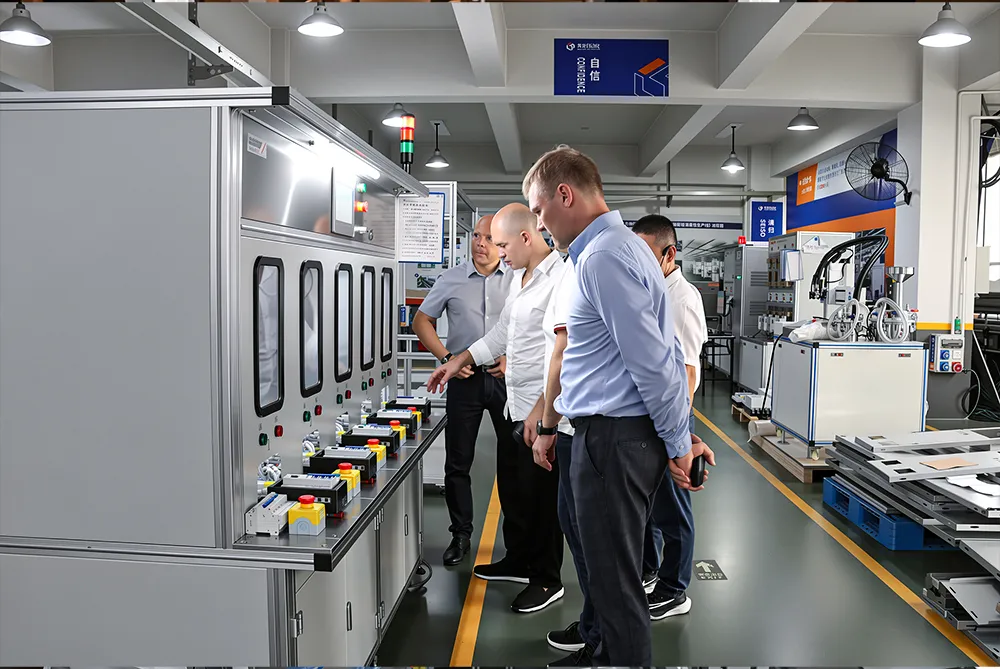

What is Automation?
Real production challenge: “Thirty percent of our time was spent transferring parts from one test area to another manually. When our operators were tired after lunch, they tended to create more defects. We wanted to know if we could reduce costs with automation and prevent these problems from continuing.” — Plant manager, a small to mid‑sized manufacturer of electrical components.
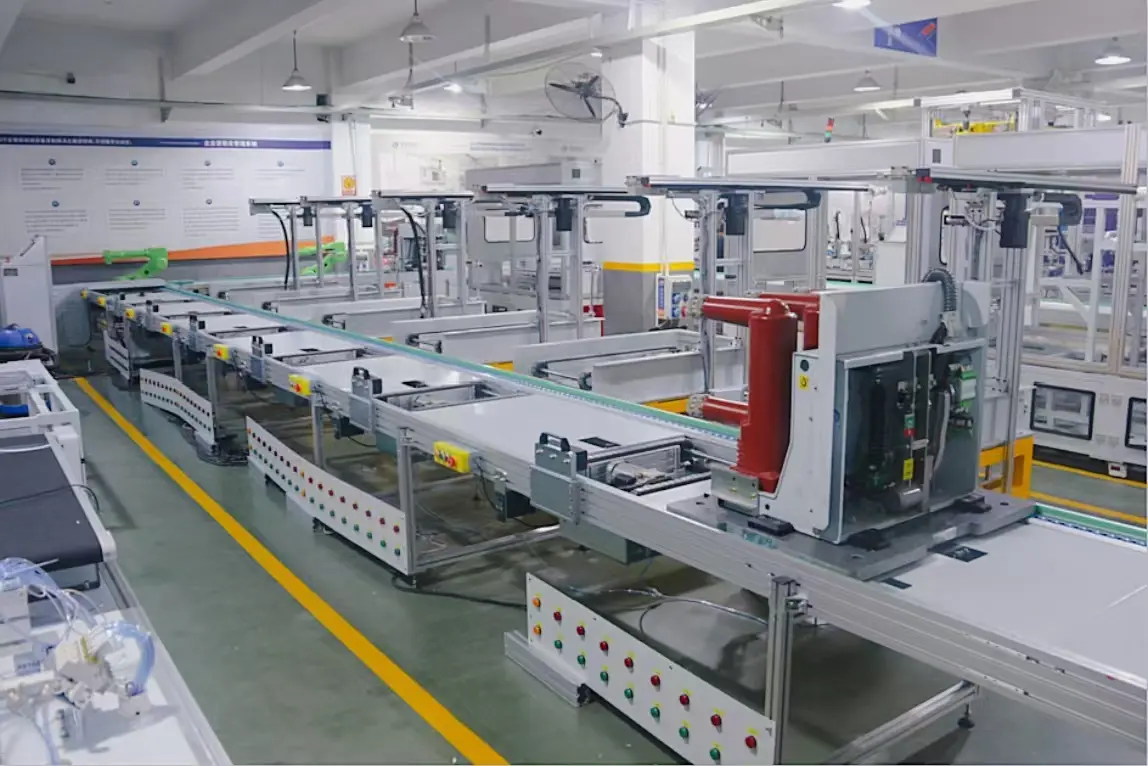
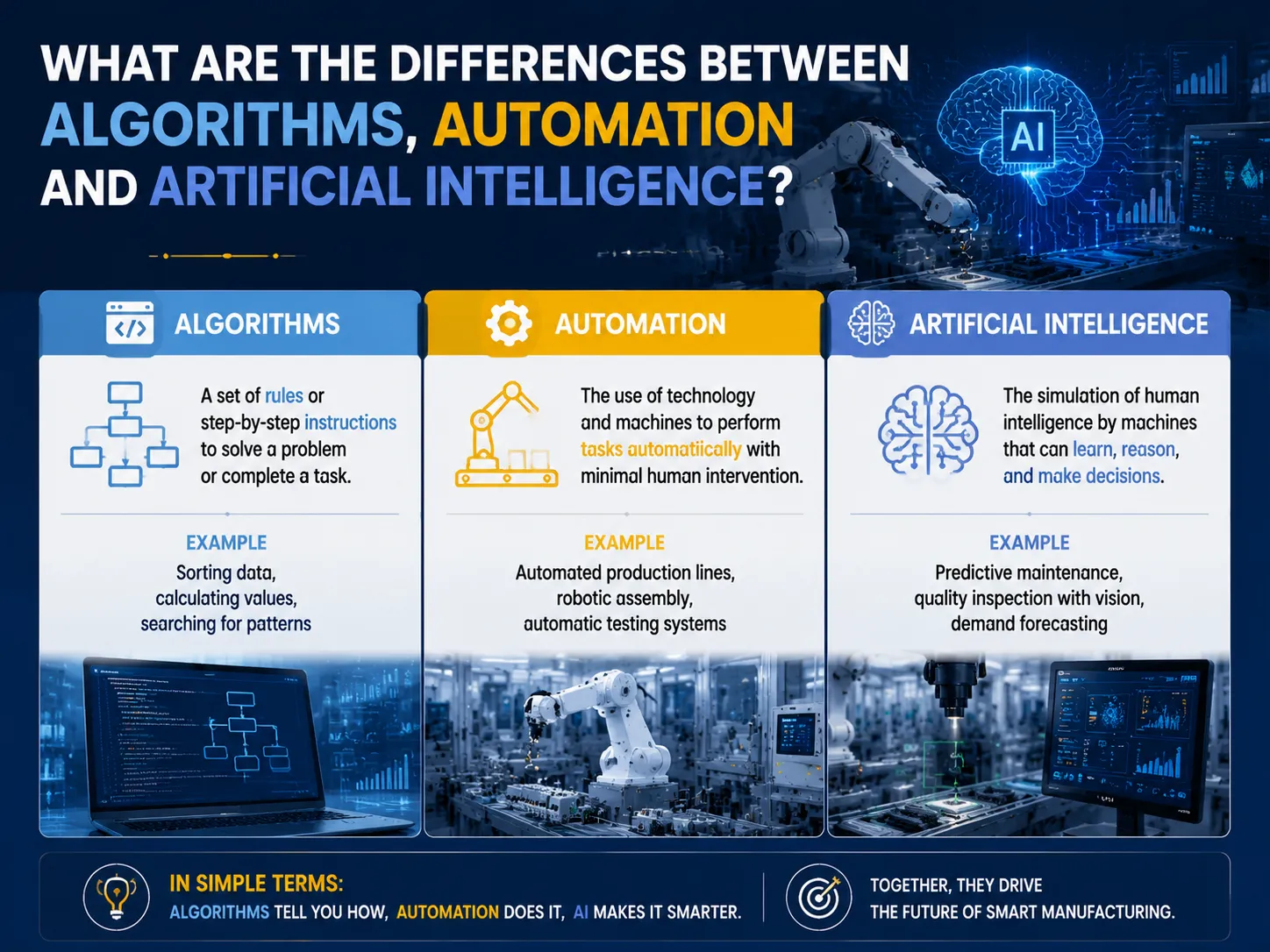
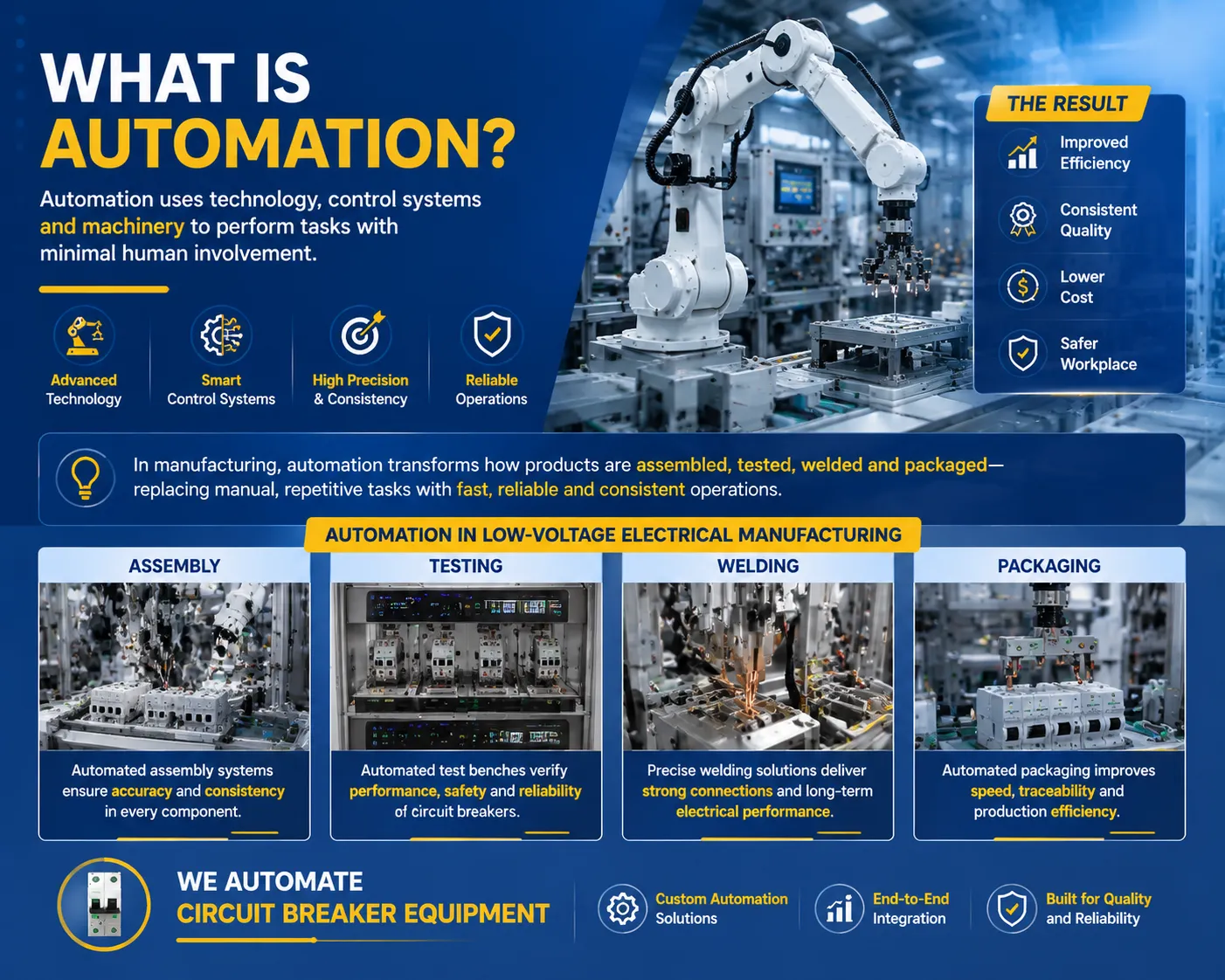
Automation refers to the utilization of technology, control systems such as PLCs and CNCs, and machinery to execute operations or activities with very little human involvement. In a manufacturing environment, automation redefines how products are assembled, tested, welded, and packaged by substituting manual, repetitive tasks with rapid, reliable, consistent operations. This guide includes definitions of automation, types of automation, practical examples, benefits, and appropriate situations for implementation. Additionally, this document includes specifics on the types of automation equipment used at low‑voltage electrical manufacturing facilities.
This guide covers:
- What is automation? (Simple explanation & technical definition)
- 4 types of industrial automation
- Key benefits for manufacturers (quality, speed, cost, safety)
- Real-world automation examples and applications
- Specific automation equipment (assembly lines, test benches, welding cells)
- When should your factory consider automation?
- How Benlong Automation helps businesses automate electrical component production
- Frequently asked questions about automation (skills, tools, job impact)
1. What is automation?
Simply put, automation means using machines, computers, or robots to complete repetitive tasks. For example, a machine picks up a silver contact, places it onto a copper terminal, welds it, and then checks the quality without anyone touching it. This turns a manual process into an automated, repeatable, and faster operation. It could be as simple as one machine (e.g., an automatic screwdriver) or an entire production line (e.g., an MCB assembly line that creates 2,000 breakers per shift).
Technical automation uses sensors, actuators, programmable logic controllers (PLCs), and software to perform predefined or real‑time feedback‑based tasks. The goals include increased productivity, greater consistency, lower labor costs, and improved workplace safety.
2. The 4 types of industrial automation
There are four main categories of automation, depending on production volume and product variety. Engineers classify automation based on the type of products and the volume to be produced.
- Fixed (hard) automation: Developed for high‑volume production of a single product (e.g., an MCB automatic line producing over a million units per day). Setup cost is high, but per‑unit cost is very low.
- Programmable automation: Can be reconfigured for batch production of different products (e.g., a test bench that calibrates both 1P and 4P circuit breakers by loading a new recipe). Changeover time is moderate (minutes to hours).
- Flexible (soft) automation: An extension of programmable automation that enables quick changeovers (typically under five minutes) between product variants. An IOT Smart MCB production line that handles many different smart breaker models is a good example – perfect for high‑mix, mid‑volume manufacturing.
- Integrated automation: Connects automated systems (assembly, welding, testing, packaging) into a fully synchronized line with centralized data management (MES). Common in large factories producing millions of breakers annually.
3. Key benefits of automation for manufacturers
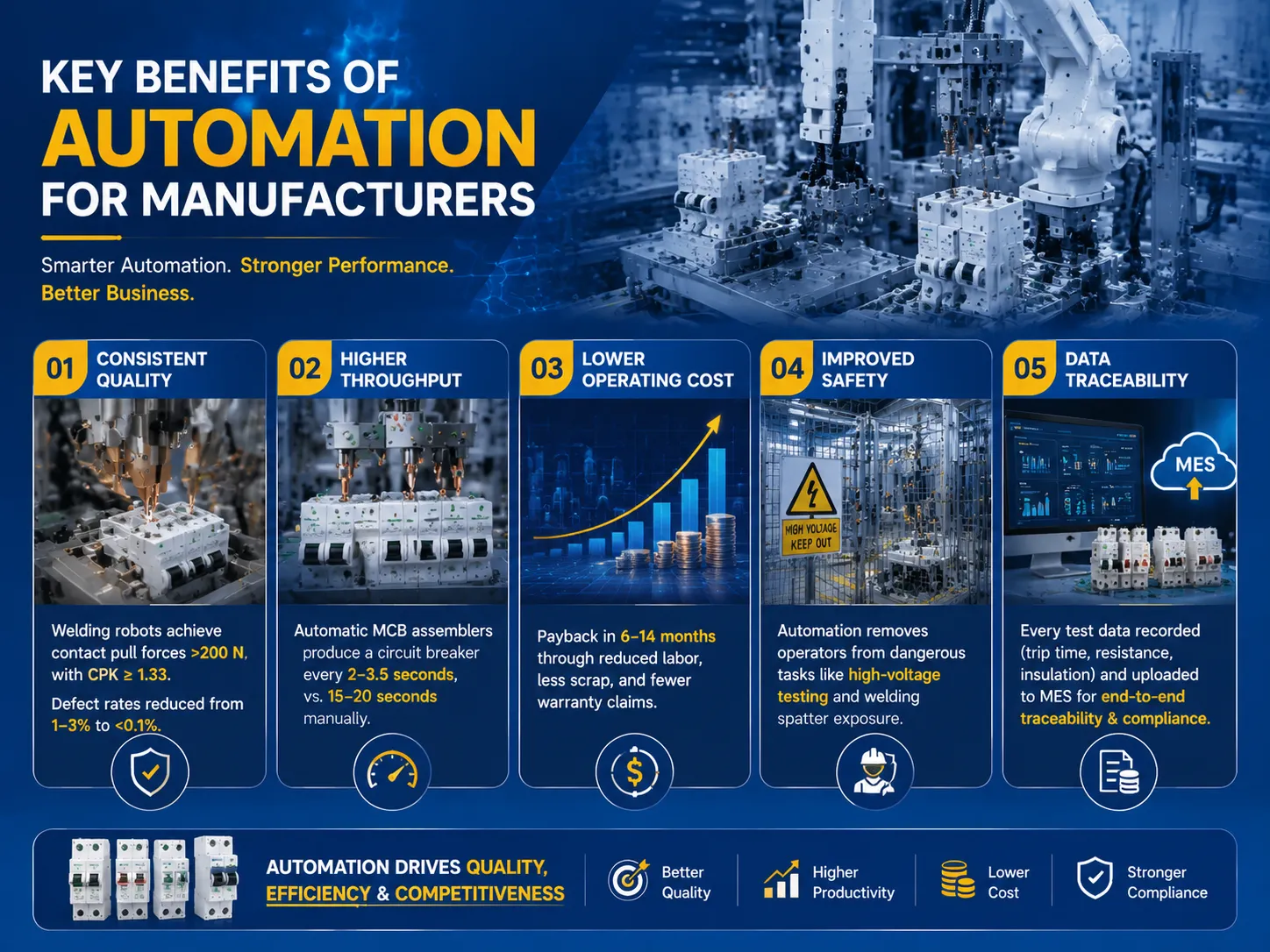
- Consistent quality: Automated welding robots achieve contact pull forces >200 N with a CPK (process capability index) of at least 1.33. Manual welding shows much higher variability, reducing defect rates from 1‑3% to below 0.1%.
- Higher throughput: Automatic MCB assemblers produce a circuit breaker every 2‑3.5 seconds, compared to 15‑20 seconds for manual assembly.
- Lower operating cost: Despite upfront capital investment, payback periods typically range from 6 to 14 months due to reduced labor, less scrap, and fewer warranty claims.
- Improved safety: Automation removes operators from dangerous jobs such as high‑voltage testing and welding spatter exposure.
- Data traceability: Automated test benches record every measurement (trip time, contact resistance, insulation value) and upload data to the manufacturing execution system (MES), providing end‑to‑end traceability – a requirement for IEC/UL certification.
4. Real-world examples of automation in electrical manufacturing
Examples of automation on factory floors include the production of low‑voltage electrical components (miniature circuit breakers, molded case circuit breakers, contactors, surge protective devices).
- Automatic silver contact welding: A servo‑driven welding machine produces consistent welds between silver tips and copper terminals via servo‑controlled energy input. It can also measure weld strength via pull‑test methods and rapidly reject parts that fail.
- MCB thermal calibration bench: This automated test bench applies 135% of rated load current, measures trip time, adjusts the bimetal screw via a stepper motor, and records all results until the trip time falls into a 45‑55 second window. All data are logged.
- Robot‑assisted assembly of arc chutes: A six‑axis robot picks arc plates from a table, places them into the housing, and uses vision to verify correct stacking. Cycle time is 1.5 seconds per pole.
- Inline functional testing of smart breakers: An IoT test bench simulates communication protocols (Wi‑Fi, Zigbee, RS485) and tests remote operation and energy meter verification.
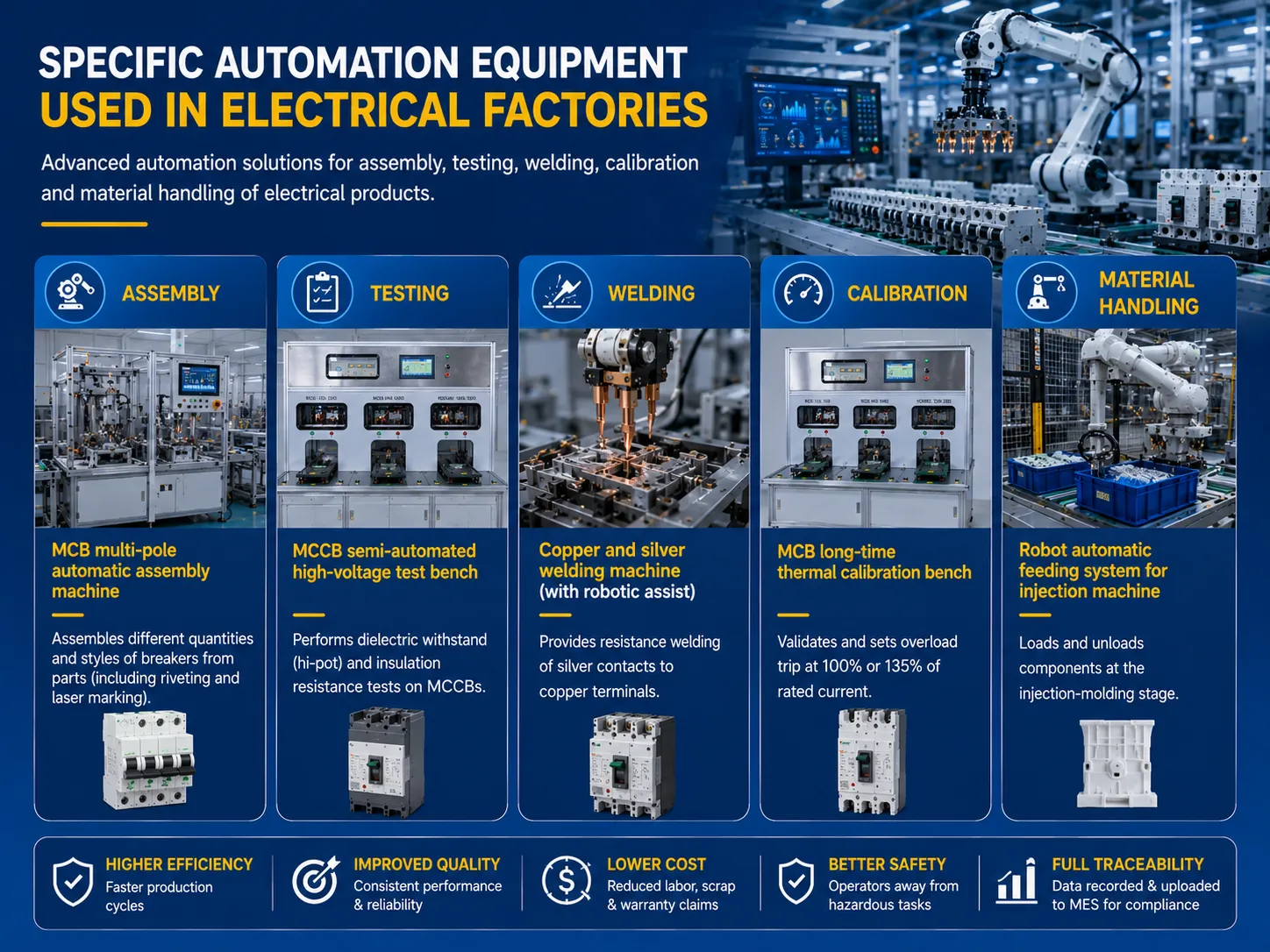
5. Specific automation equipment used in electrical factories
Here are actual machine types that manufacturers deploy:
Equipment category Example Purpose Assembly MCB multi‑pole automatic assembly machine Assembles different quantities and styles of breakers from parts (including riveting and laser marking).Testing MCCB semi‑automated high‑voltage test bench Performs dielectric withstand (hi‑pot) and insulation resistance tests on MCCBs.Welding Copper and silver welding machine (with robotic assist)Provides resistance welding of silver contacts to copper terminals.Calibration MCB long‑time thermal calibration bench Validates and sets overload trip at 100% or 135% of rated current.Material handling Robot automatic feeding system for injection machine Loads and unloads components at the injection‑molding stage.
6. When does your factory need automation?
You should seriously consider automation if you answer “yes” to any of these questions:
- High volume: Do you produce more than 500,000 units of a similar product per year?
- Quality issues: Is your defect rate above 1% due to human error (e.g., inconsistent welding or calibration)?
- Repetitive tasks: Do operators perform the same three steps (load, press, unload) repeatedly every few seconds, causing increased fatigue or risk of injury?
- Traceability requirement: Do your customers (e.g., ABB, Schneider, Siemens) require 100% test data per product?
- Labor shortage: Are you struggling to hire and retain skilled technicians for manual assembly/testing?
- Changeover frequency: Do you change product models more than twice per shift, and does current changeover take >30 minutes?
If you meet any of the criteria above, purchasing an automated solution – even a single work cell or a semi‑automated bench – will provide financial returns within one year.
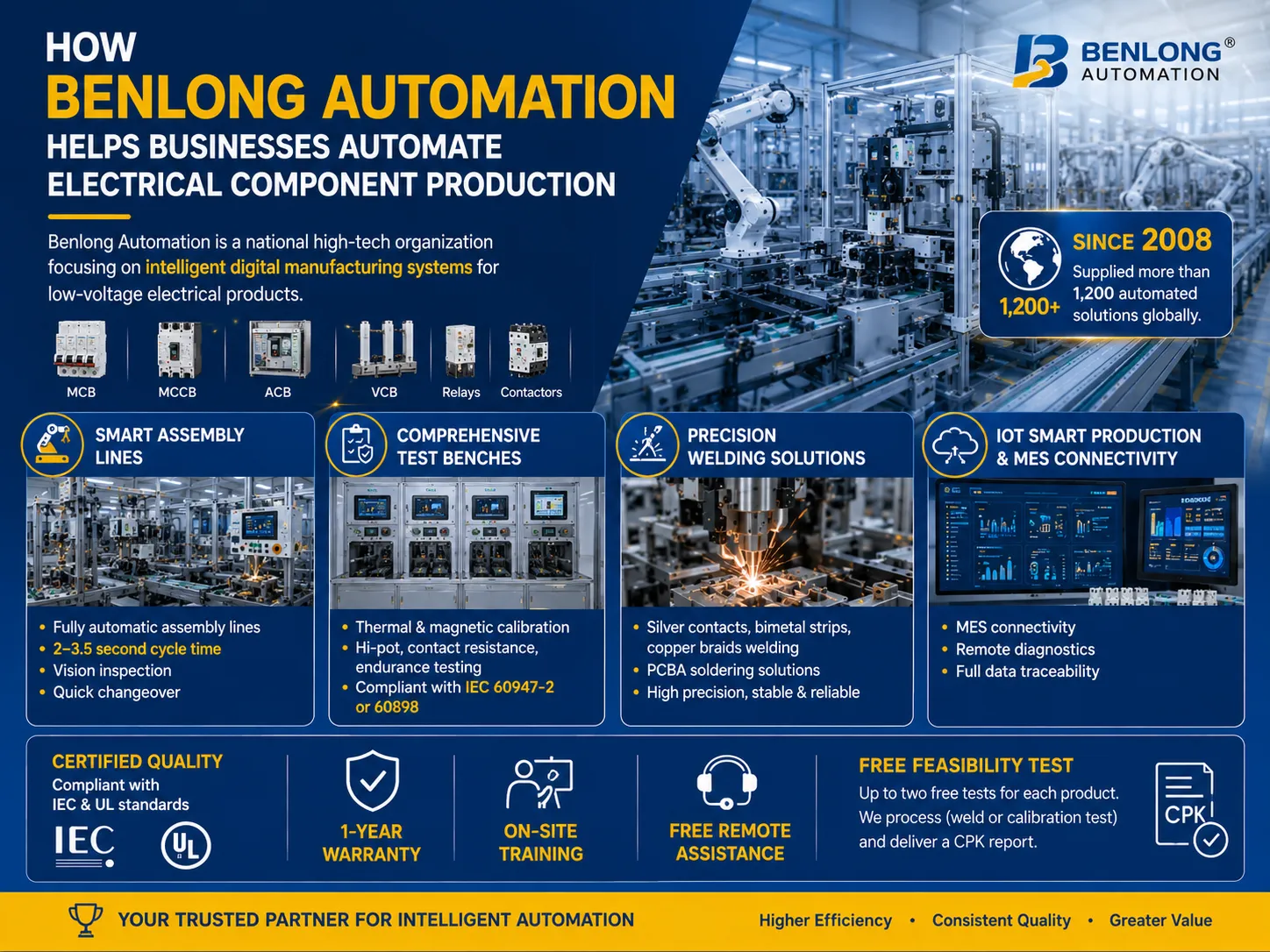
7. How Benlong Automation helps businesses automate electrical component production
Benlong Automation is a national high‑tech organization focusing on intelligent digital manufacturing systems for low‑voltage electrical products (MCB, MCCB, ACB, VCB, relays, contactors, etc.). Since commencing operations in 2008, we have supplied more than 1,200 automated solutions globally.
- Fully automatic assembly lines with 2‑3.5 second cycle time, vision inspection, and quick changeover.
- Comprehensive test benches for thermal and magnetic calibration, hi‑pot (high potential), contact resistance, and endurance testing (typically in accordance with IEC 60947‑2 or 60898).
- Precision welding machines for silver contacts, bimetal strips, copper braids, and PCBA soldering.
- IoT smart production lines with MES connectivity, remote diagnostics, and full data traceability.
We manufacture our products in compliance with IEC and UL standards. All products come with a one‑year warranty and on‑site training. Remote assistance is provided at no cost. Additionally, we conduct up to two free feasibility tests for each product sent to us. We will process the product – either via weld or calibration test – and deliver a CPK report upon completion.
8. Frequently asked questions (FAQ)
What is automation in simple words?
To automate a process means to perform repetitive tasks without human involvement, using machines, computers, or robots. An example is a machine that selects a silver contact, positions it onto a terminal, welds it, and inspects for quality – each step occurring without human intervention, allowing faster processing, more consistent output, and less reliance on individual expertise.
What are the 4 types of automation?
There are four main types: fixed (large single‑product run), programmable (batch production, reprogrammable), flexible (quick changeover between mixed products), and integrated (entire line with central control). Each type suits specific volume and variety needs.
What is an example of automation?
A great example in low‑voltage electrical manufacturing is the MCB automatic testing line. It automatically loads circuit breakers, tests them for instantaneous trip (B/C/D curves), thermal calibration, dielectric strength, and contact resistance, then sorts them into pass/fail bins – a fully automated process with no manual intervention.
What are the top 5 automation tools?
The main tools for industrial processes include PLCs (Programmable Logic Controllers), HMIs (Human‑Machine Interfaces), SCADA (Supervisory Control and Data Acquisition), robotic arms (articulated or Cartesian), and servo‑driven actuators. Additional tools may include vision systems, resistance welding controllers, or testing instruments.
What skills are needed for automation?
Key competencies include: PLC ladder logic programming, sensor and actuator knowledge, basic robotics, data communication protocols (Modbus & Ethernet/IP), understanding of your specific manufacturing process (welding, calibration, etc.), and all aspects of preventative maintenance and corrective action.
What is another name for automation?
Synonyms include industrial automation, process automation, production automation, and manufacturing automation. The terms mechatronics and control systems are related but not exact synonyms in all contexts.
What jobs can automation replace?
Repetitive, manual tasks such as manual welding, manual testing and inspection, simple assembly (e.g., screw driving, riveting), material handling, and packaging are generally replaced by automation. Skilled engineers, maintenance technicians, and process designers are not replaced; instead, they are empowered to shift from completing the task to optimizing the system.
Automation is the strategic method of turning production upside‑down by replacing slow, inconsistent manual labor with automated, quick, highly repeatable, and data‑driven processes. Understanding the four types of automation helps you identify the correct method based on your volume and variety. The benefits – lower defect rates, increased throughput, decreased costs, and increased safety – are extensively proven and well documented. When producing low‑voltage electrical components, certain types of automated machinery (assembly lines, test stands, welding cells) are readily available from suppliers such as Benlong Automation. Evaluate your production challenges against the six “when to automate” questions; if you have answered “yes” to any, the next step is to request an initial feasibility study. Automation does not exist to eliminate human beings, but to provide them with better tools.